Every year, thousands of pre-medical students in Pakistan dream of getting admission into MBBS or BDS. In 2026, the competition is expected to be even tougher than before. Limited seats, high scores, and strict merit rules mean even 0.1% can decide your future.
This is exactly why MDCAT aggregate calculation matters so much.
Most students work hard for FSc and MDCAT, but many still feel confused about one question:
“Do I have enough merit to get admission?”
Without knowing your exact aggregate, it is impossible to judge:
- Which medical colleges you can apply to
- Whether MBBS is possible or BDS is a safer option
- If you should repeat MDCAT or not
MDCAT 2026: High Competition, Low Margin
In 2026, MDCAT will again be a high-pressure, high-competition exam across Pakistan. Thousands of students will score above 170+, but only top aggregates make it to government colleges. Private colleges also use merit, so calculation is important everywhere.
A small mistake in understanding merit weightage can lead to:
- Wrong expectations
- Wrong college preferences
- Missed admission chances
Why Merit Calculation Is Critical for MBBS & BDS
Admission to MBBS and BDS is not based on MDCAT marks alone. Your aggregate score is calculated using:
- MDCAT marks
- FSc (Pre-Medical) marks
- Sometimes Matric marks (depending on province)
This combined score is what universities actually use to prepare merit lists. Knowing your aggregate early helps you plan smartly instead of guessing.
Role of PMDC, UHS & Provincial Merit Systems
Medical admissions in Pakistan follow rules set by:
- PMDC (Pakistan Medical & Dental Council)
- UHS (University of Health Sciences)
- Other provincial bodies like SZABMU, KMU, and BUMHS
Each authority follows a defined weightage formula. An MDCAT Aggregate Calculator based on these rules ensures your calculation is accurate and reliable, not random.
Who Should Use an MDCAT Aggregate Calculator?
This calculator is useful for:
- Pre-medical students checking their chances after MDCAT
- Repeaters comparing improvement from previous attempts
- Parents who want a clear, simple understanding of merit
- College counselors guiding students properly
In short, if medical admission matters to you in 2026, knowing your exact MDCAT aggregate is not optional — it is essential.
What Is MDCAT Aggregate?
The MDCAT aggregate is your final merit percentage used for medical admissions in Pakistan. It is not just your MDCAT marks. Instead, it is a combined score made from different academic results.
In simple words:
MDCAT Aggregate = Your overall merit score for MBBS or BDS admission
Universities do not select students by looking at MDCAT marks alone. They calculate an aggregate so that a student’s academic background and test performance are both considered fairly.
Why Universities Use Aggregate Instead of Marks Alone
If admissions were based only on MDCAT marks, students with weak academic records could still get admission. To avoid this, universities combine:
- Your FSc (Pre-Medical) or A-Level result
- Your MDCAT test score
This system ensures:
- Fair competition
- Equal opportunity for serious, consistent students
- Better quality medical professionals
That is why merit lists are always based on aggregate percentage, not raw marks.
MDCAT Marks vs Final Merit Percentage
Many students confuse MDCAT marks with aggregate. They are not the same.
| Term | Meaning |
|---|---|
| MDCAT Marks | Your score in the MDCAT exam (out of 200) |
| MDCAT Aggregate | Final merit percentage used for admission |
| Purpose | Determines your rank in merit list |
A student with 180 MDCAT marks may still lose a seat to someone with 175 marks if their FSc percentage is higher. This shows how important aggregate calculation is.
MDCAT Aggregate Formula 2026 (Latest Update)
For MDCAT 2026, medical universities across Pakistan are expected to follow the PMDC-approved weightage system. This formula is simple but must be calculated correctly.
Official MDCAT Weightage (2026)
Below is the standard weightage used by most provinces:
| Component | Weightage |
|---|---|
| FSc (Pre-Medical) / A-Level Equivalence | 50% |
| MDCAT Test | 50% |
| Total Aggregate | 100% |
Note: A-Level students use IBCC equivalence percentage instead of FSc marks.
MDCAT Aggregate Formula (Example)
Let’s understand the formula with an easy, real-life example.
Step-by-Step Breakdown
Step 1: Calculate FSc Percentage
Suppose a student scored 990 out of 1100 in FSc.
FSc Percentage =
990 ÷ 1100 × 100 = 90%
Now apply weightage:
90 × 50% = 45
Step 2: Calculate MDCAT Percentage
Suppose the student scored 170 out of 200 in MDCAT.
MDCAT Percentage =
170 ÷ 200 × 100 = 85%
Apply weightage:
85 × 50% = 42.5
Step 3: Final MDCAT Aggregate
| Component | Score |
|---|---|
| FSc Contribution | 45 |
| MDCAT Contribution | 42.5 |
| Final Aggregate | 87.5% |
Final Result
MDCAT Aggregate = 87.5%
This 87.5% is the number that decides:
- Your merit position
- Your chance for MBBS or BDS
- Which medical colleges you can apply to
MDCAT Aggregate Calculator 2026 – How It Works
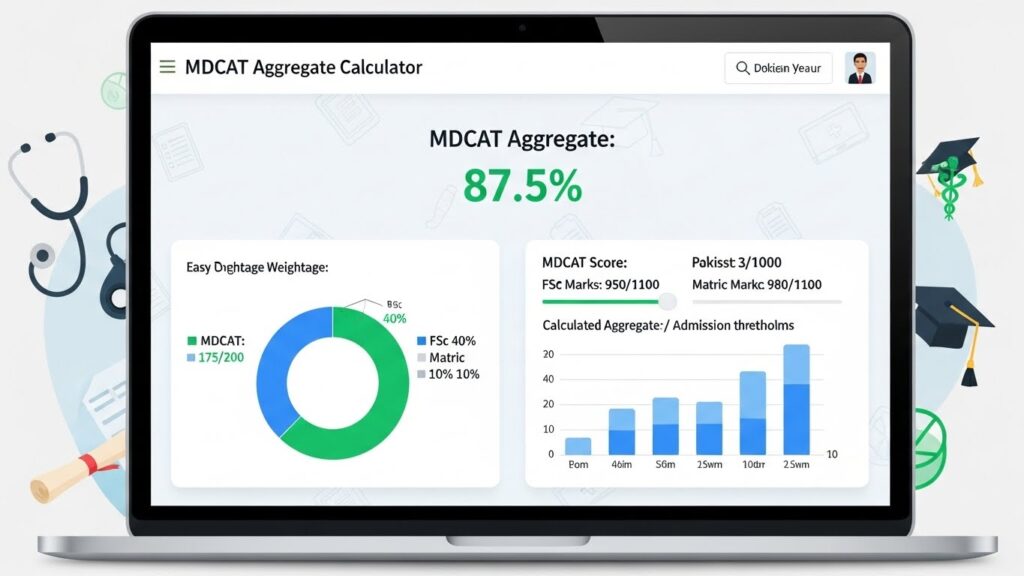
An MDCAT Aggregate Calculator 2026 is a simple online tool that helps you calculate your exact merit percentage in seconds. It removes confusion, manual errors, and wrong assumptions.
Instead of guessing your chances, you get a clear, accurate result that matches official merit formulas.
What Inputs Does the Calculator Need?
To calculate your aggregate correctly, the calculator usually asks for:
- FSc (Pre-Medical) marks
or - A-Level IBCC equivalence percentage
- MDCAT marks (out of 200)
That’s it. No complex fields, no confusing options.
How Results Are Generated Instantly
Once you enter your marks, the calculator:
- Converts your marks into percentages
- Applies official MDCAT 2026 weightage
- Adds both scores to generate your final aggregate
All calculations are done automatically using the latest PMDC-approved formula. Results appear instantly, without delay.
Accuracy and Reliability
A good MDCAT calculator is:
- Based on official merit weightage
- Free from manual calculation errors
- Useful for all provinces
- Updated for MDCAT 2026 rules
This means you can trust the result when making admission decisions.
Who Should Use This Calculator?
This calculator is helpful for every medical aspirant, including:
First-Time MDCAT Candidates
Students appearing in MDCAT for the first time can:
- Check expected merit
- Set realistic admission goals
- Shortlist colleges wisely
Improvement Students
Repeaters can:
- Compare old vs new aggregate
- Measure improvement accurately
- Decide if another attempt is needed
A-Level Students
A-Level candidates can:
- Avoid confusion with equivalence
- Calculate merit using IBCC percentages
- Compete fairly with FSc students
MDCAT Aggregate for MBBS vs BDS
The aggregate requirement for MBBS and BDS is not the same. Understanding this difference helps you apply smartly.

Expected Closing Merits (Trend-Based)
Below are approximate trends, not guarantees:
| Program | Government Colleges (Trend) |
|---|---|
| MBBS | 88% – 92% |
| BDS | 85% – 88% |
These figures are based on recent admission trends and may change in 2026.
Difference in Competition Level
- MBBS has very high competition due to limited seats
- BDS has slightly lower merit but is still competitive
Many students with good aggregates miss MBBS by a small margin and secure BDS instead.
Why Small Percentage Changes Matter
In MDCAT merit lists:
- 0.1% can move you up or down hundreds of positions
- One extra MCQ correct can change your future
This is why knowing your exact aggregate is more important than rough estimates.
MDCAT Aggregate for A-Level Students (2026)
A-Level students follow the same merit system, but with one key difference: IBCC equivalence.
Importance of IBCC Equivalence
Universities do not accept raw A-Level grades. They use:
- IBCC-issued equivalence percentage
Without equivalence:
- Your aggregate cannot be calculated
- You cannot be included in merit lists
Common Mistakes A-Level Students Make
Many A-Level students:
- Use guessed percentages instead of IBCC values
- Ignore subject-wise requirements
- Apply late for equivalence
These mistakes can lower merit or delay admission.
How the Calculator Adjusts Equivalence
A proper MDCAT Aggregate Calculator:
- Uses IBCC equivalence percentage directly
- Applies correct 50% weightage
- Ensures fair comparison with FSc students
This makes the calculator especially useful for A-Level candidates in MDCAT 2026.
Common Mistakes While Calculating MDCAT Aggregate
Many students lose confidence or make wrong admission decisions because of small but serious calculation mistakes. Avoiding these errors can save you from unnecessary stress.
Using Wrong Weightage
One of the most common mistakes is using an old or incorrect formula. Some students still calculate aggregate using:
- Matric marks
- Unequal weightage
For MDCAT 2026, most universities follow 50% FSc / A-Level + 50% MDCAT. Using any other ratio can give a false result.
Ignoring Equivalence Certificates
A-Level students often calculate merit using:
- Estimated percentages
- School-issued conversions
Universities only accept IBCC equivalence certificates. Ignoring this can:
- Lower your calculated aggregate
- Delay your admission process
Always use official equivalence values.
Rounding Errors
Manual calculations often cause:
- Incorrect rounding
- Decimal mistakes
Even 0.05% matters in merit lists. This is why online calculators are safer than hand calculations.
Trusting Outdated Formulas
Admission policies change. Calculators or blog posts from older years may:
- Use old PMDC rules
- Ignore recent updates
Always ensure the calculator is updated for MDCAT 2026.
MDCAT Merit Trends (Previous Years Overview)
Understanding past merit trends helps you set realistic expectations.
How Merit Has Increased Year by Year
Over the last few years:
- MDCAT competition has increased
- Average scores have gone higher
- Government seats remain limited
This steady rise means that merit rarely drops, even if the paper feels difficult.
What Students Should Realistically Expect in 2026
For MDCAT 2026:
- High aggregates will remain essential for MBBS
- BDS merit will also stay competitive
- Private colleges may slightly vary in merit
Students should focus on planning with data, not hope.
Strategy for Borderline Aggregates
If your aggregate is near the closing merit:
- Apply to multiple colleges
- Include both MBBS and BDS preferences
- Monitor merit list updates carefully
Smart application strategy matters as much as marks.
Tips to Improve Your MDCAT Aggregate
If your aggregate is not strong enough, there are still practical options.
Retaking MDCAT
Repeating MDCAT can help if:
- You underperformed due to pressure
- You know where you lost marks
Even a 5–10 mark improvement can significantly raise your aggregate.
Improving FSc Marks
Improvement exams are another option:
- FSc contributes 50% to aggregate
- Better board marks improve merit permanently
This option is useful for repeaters.
Choosing Private vs Public Medical Colleges
If government merit is too high:
- Private colleges offer more seats
- Merit is slightly lower
- Fees are higher, but timelines are flexible
Knowing your aggregate helps you choose realistic and affordable paths.
Frequently Asked Questions (FAQs)
How do I calculate MDCAT aggregate for 2026?
To calculate your MDCAT aggregate for 2026, you need:
Your FSc (Pre-Medical) percentage or A-Level IBCC equivalence percentage
Your MDCAT marks (out of 200)
Both are converted into percentages and combined using 50% FSc / A-Level + 50% MDCAT weightage. Using an online MDCAT Aggregate Calculator is the easiest and most accurate method.
What is a good MDCAT aggregate for MBBS?
A “good” MDCAT aggregate depends on competition, but based on recent trends:
88% and above gives a strong chance in government MBBS colleges
85%–87% may be borderline for MBBS, stronger for BDS
Below 85% usually shifts focus toward private colleges
Remember, these are trends, not guarantees.
Is this MDCAT aggregate calculator accurate?
Yes, a properly designed MDCAT Aggregate Calculator is accurate because:
It follows official PMDC-approved formulas
It eliminates manual calculation errors
It uses updated weightage for MDCAT 2026
Accuracy depends on entering correct marks or equivalence.
Does MDCAT aggregate differ by province?
The basic aggregate formula remains the same across provinces. However:
Closing merits may differ
Seat availability varies
Provincial quotas affect final selection
That is why knowing your aggregate helps you plan province-wise applications.
How much weight does MDCAT carry in 2026?
For MDCAT 2026:
MDCAT = 50%
FSc / A-Level = 50%
Both parts are equally important. Ignoring either can reduce your chances significantly.
Conclusion – Calculate Smart, Plan Early
In MDCAT 2026, success is not just about hard work—it is about smart planning. Knowing your MDCAT aggregate early helps you:
- Set realistic expectations
- Choose the right colleges
- Avoid last-minute stress
An accurate MDCAT Aggregate Calculator gives you clarity, confidence, and control over your admission journey.
No matter where you stand—high merit, borderline, or improving—early calculation leads to better decisions.